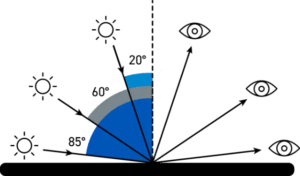
Gloss is the visual sensation associated with the perceived brightness of direct light reflected from a surface. A glossmeter measures the specular part of the reflection, so a matte surface can reflect a lot of light diffusely and still read low gloss.
Gloss meters quantify this effect by measuring the specular light reflection from a surface at an equal but opposite angle of illumination at defined angles.
The Gloss Unit (GU) is defined in international standards including ISO 2813 and ASTM D523. It is determined by the amount of reflected light from a glass standard of known refractive index.
The measurement angles most commonly used for gloss are 20°, 60° and 85°.
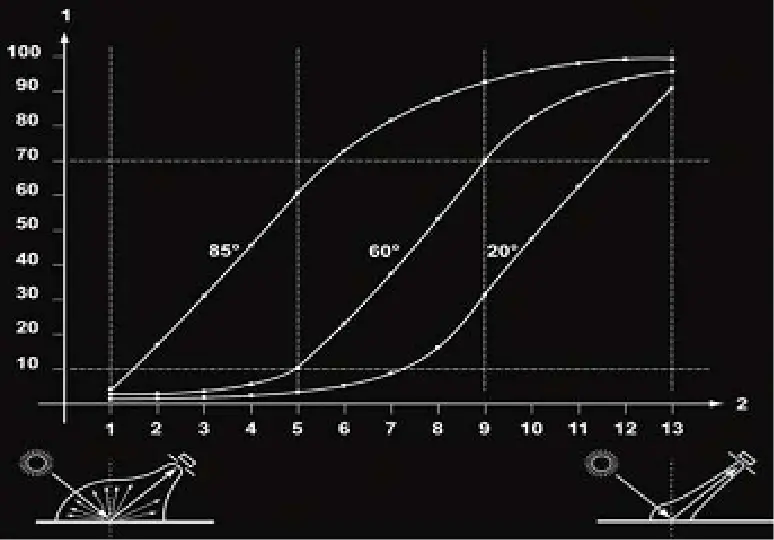
The most appropriate angle should be selected dependent on the glossiness of the sample surface.
Using the correct measurement geometry increases resolution and improves the correlation of results with human perception of quality.
To determine the correct measurement angle the surface should be assessed with the 60° geometry-
On a matte surface the 60° gloss reading is low and small differences between samples are hard to resolve, so 85° is used. On a high gloss surface 60° readings are close together and small differences are hard to resolve, so 20° is used.
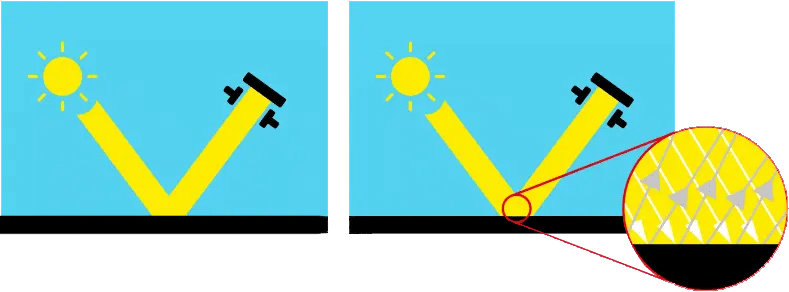
Law of reflection is the direction of incoming light and the direction of outgoing light reflected make the same angle with respect to the surface.
The standard method for measuring gloss using a gloss meter at 20° requires an acceptance angle of ± 0.9° around the specular angle of 20°.
This narrow angular measurement range of reflected light does not allow the sensor in a gloss meter to detect the texture on a surface as the structures within the texture cause the reflected light to be deflected at a greater angle.
The Rhopoint IQ is different to a gloss meter as it uses a linear diode array (LDA) at 20° to measure the distribution of reflected light between 12.75° – 27.25°.
Conventional glossmeter optics are used at 60° & 85° and these fully comply with international gloss standards such as ISO 2813 and ASTM 523.
The instrument does not have physical receiver apertures like a conventional gloss meter; the 20° gloss value is obtained by measuring with the elements of the linear array that correspond to the angles specified in the standards.
This feature allows the instrument to quantify the effects of texture on a surface that can be classified as either orange peel or haze according to their size.